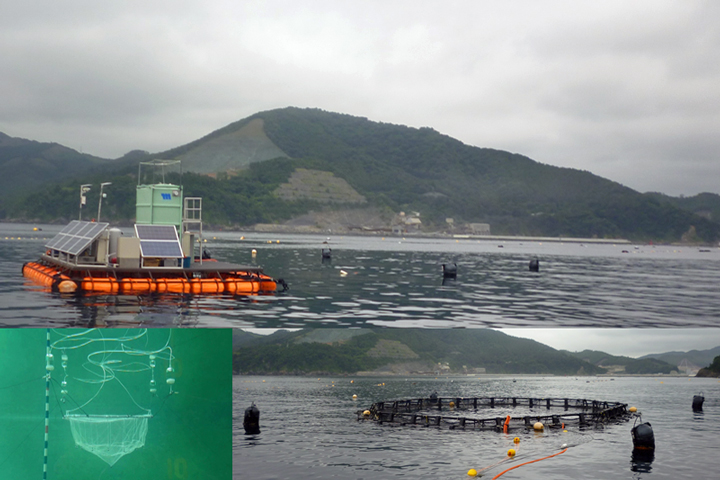
We have developed a controllable depth cage (CDC) that can be freely positioned in the vertical direction by changing the buoyancy of the intermediate float or cage. Normally, the buoyancy and weight of a cage are not balanced in the water, resulting in rising or sinking as a single body. However, in a mooring system using intermediate floats, the vertical position of a cage can be controlled at the position where the buoyancy of the intermediate float, the weight of the cage and the tension of the mooring rope are balanced. The vertical position of the cage can be adjusted in response to changes in the natural environment such as high waves, high water temperature, red tide, and hypoxic water. A sea trial was conducted in Onagawa Bay, Miyagi Prefecture. Please see this page for details.
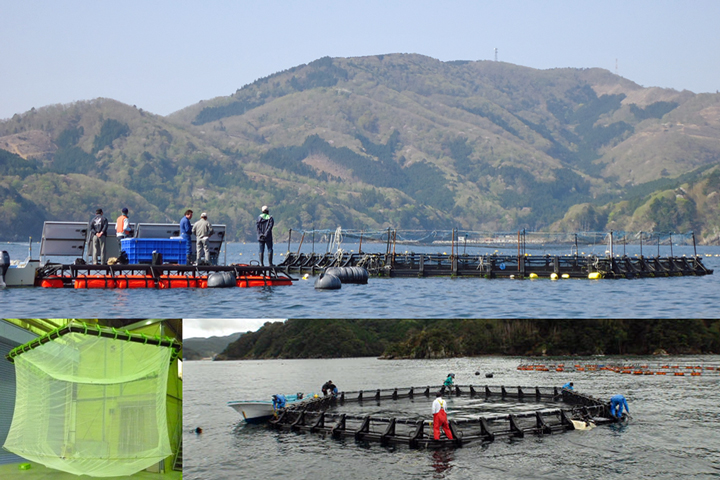
For general cages composed of polyethylene frames, the cages can be reliably floated and submerged by injecting and exhausting air to and from the flexible hoses inside the polyethylene pipe. A sea trial was conducted in Onagawa, Miyagi Prefecture, where silver salmon are cultivated. However, since silver salmon die if the temperature exceeds 21 degrees for a long time, it is necessary to finish shipping by July when breeding in the surface layer. By cultivating silver salmon at a depth of 10 to 20 m, where the water temperature is lower, using a developed submergible cage, we succeeded in prolonging the aquaculture period and adjusting shipments. Please see this page for details.
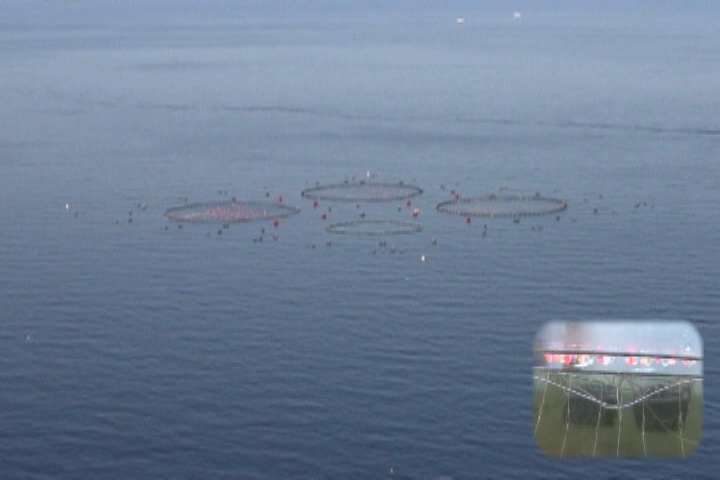
Cages using high-density polyethylene pipes are widespread all over the world. When using this cage in harsh waters, the cage should have a submergible function. By replacing air and seawater in the polyethylene pipe, the cage can be floated and submerged. However, air and seawater cannot be replaced sufficiently since the polyethylene pipe is flexible. Therefore, we have developed a large submergible cage by improving the internal structure of the polyethylene pipe to smoothly replace seawater and air. We conducted a sea trial using a developed cage for tuna in Kashiwajima, Kochi Prefecture, and demonstrated that it can withstand high waves when the cage is submerged. This cage is being introduced overseas as well. Please see this page for details.
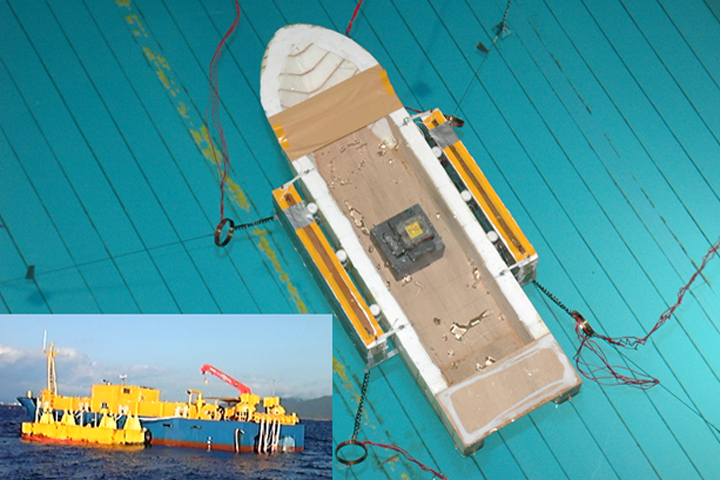
We have developed a barge that automatically feeds fish in submerged cages in an exposed sea. The construction cost including the mooring system will be expensive If the barge can withstand huge waves due to typhoon attack. Therefore, we evacuated the barge into the port if the significant wave height exceeds 4 m several times a year. The automated feeding system using this barge has made it possible to feed fish even when the significant wave height is about 1.5 to 4 m, in which feeding boats cannot approach the farming site. A sea trial was conducted at a yellowtail farm in Shibushi Bay, Miyazaki and Kagoshima prefectures.
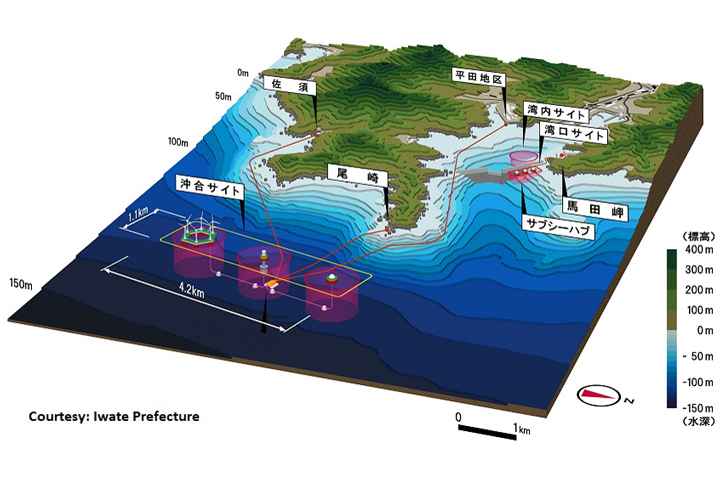
This research group was established after the Great East Japan Earthquake. A low-carbon city or region that is secure against tsunami disaster is proposed by exploring the path of "urban regeneration using marine space and ocean renewable energy". This is a field-integrated and cross-disciplinary research that goes beyond the conventional idea of separating land and sea. Not only researchers related to ocean energy, but also researchers from a wide variety of fields such as architecture gathered and discussed a low-carbon city with marine energy through symposiums. Please see this page for details (Japanese Only).
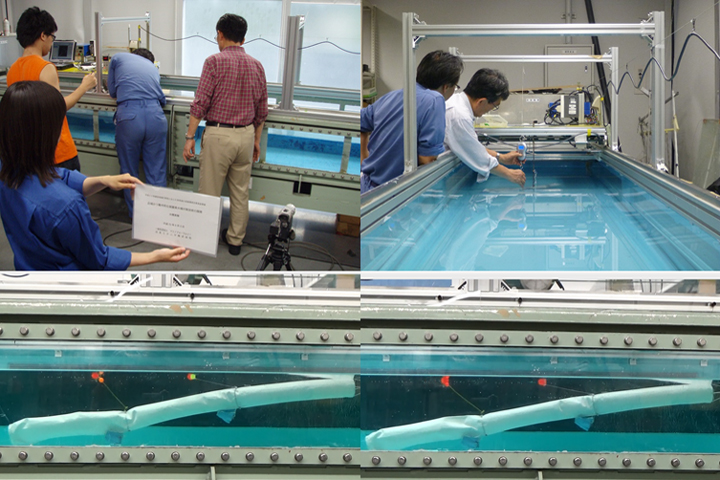
In the Ariake Sea, hypoxic waters occur widely, and the impacts on shellfish have become a problem. In this research, we developed a system that supplies oxygen to hypoxic waters using an inexpensive and easy way for fishermen. Specifically, by towing the flexible hose at certain angle, the oxygen-rich seawater in the surface layer is supplied to the bottom layer. Shellfish close their shells and wait for oxygen to be supplied in anoxic waters, but the developed method allows them to temporarily obtain oxygen and breathe. Please see this page for details.
When pollutants are detected in water, we have to immediately identify the source of pollution and take countermeasures. In this research, we used a reverse simulation that solves the governing equations in reverse in time. We investigated a method to suppress the instability of numerical simulation that occurs when solving the diffusion term in reverse in terms of time. Assuming the occurrence of the pollution problem in Lake Biwa, we conducted a reverse simulation to identify the pollution source. Please see this page for details.
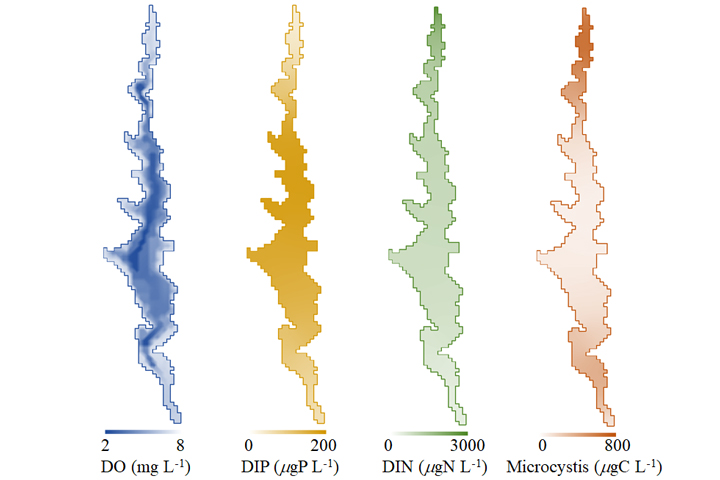
In Lake Kasumigaura, changes in algae species and the outbreak of harmful algae with toxins have become problems. We included multiple species of algae in the hydrodynamic and ecosystem coupled numerical model, and investigated the cause of the change in algae species that occurred in Lake Kitaura. In addition, we introduced a toxin model into the hydrodynamic and ecosystem coupled numerical model to reproduce the occurrence of harmful algae with toxins by simulation. We discussed the environmental conditions when harmful algae grows.
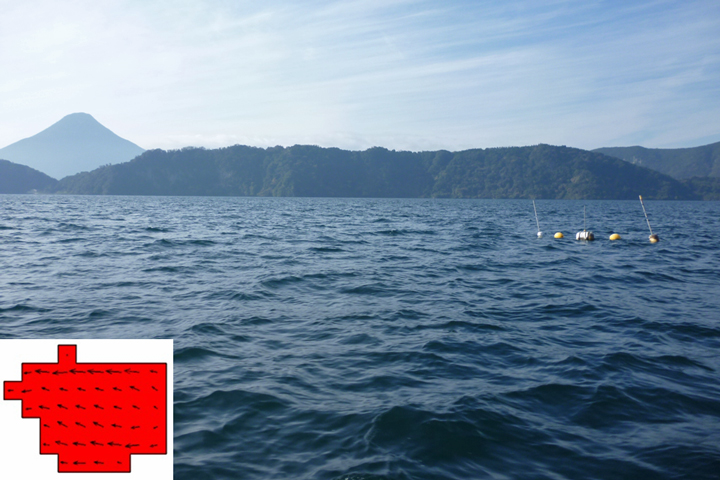
In recent years, the loss of overturn has occurred in Lake Biwa due to climate change. In Lake Ikeda in Kagoshima Prefecture, the loss of overturn has been common since the latter half of the 1980s. The overturn occurred in the 2010s, however the loss of overturn has continued again. We research to elucidate the reason why the overturn does not occur by performing numerical simulation of water quality using a hydrodynamic and ecosystem coupled numerical model.
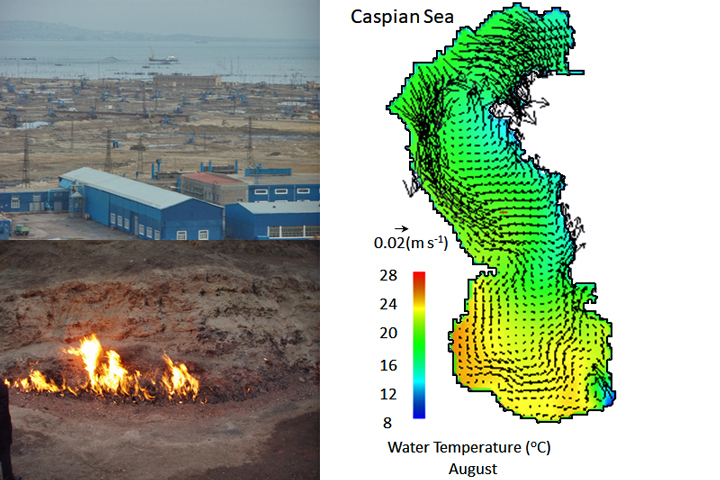
Oil and gas fields are being actively developed in and around the Caspian Sea. On the other hand, if oil pollution occurs in the Caspian Sea, there are concerns about its impact on organisms such as sturgeon that produce caviar. Therefore, in order to predict the diffusion range of oil when oil pollution occurs from the oil field, we conducted a numerical simulation of the physical environment. The circulation driven by the distribution of salinity and water temperature was reproduced. Please see this page for details.
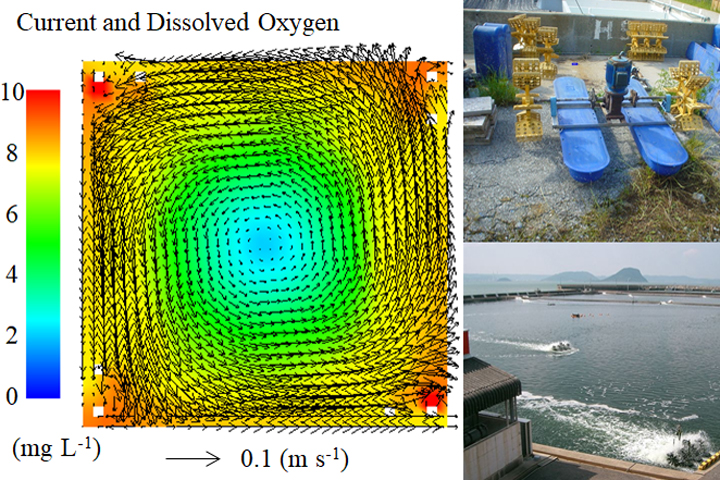
Shrimp farming is popular around Southeast Asia. Shrimp are cultured in a pond with a size of about 1 ha and a depth of about 1 to 2 m for 3 to 4 months before being harvested. In shrimp farming ponds, the concentration of dissolved oxygen decreases due to excretion of shrimp, etc. Using paddle wheel aerators, oxygen is supplied and sludge on the bottom of the pond is collected at the center of the pond to elminate it. In order to optimize the number and arrangement of paddle wheel aerators, we have developed a simulation tool using a hydrodynamic and ecosystem coupled numerical model. Please see this page for details.
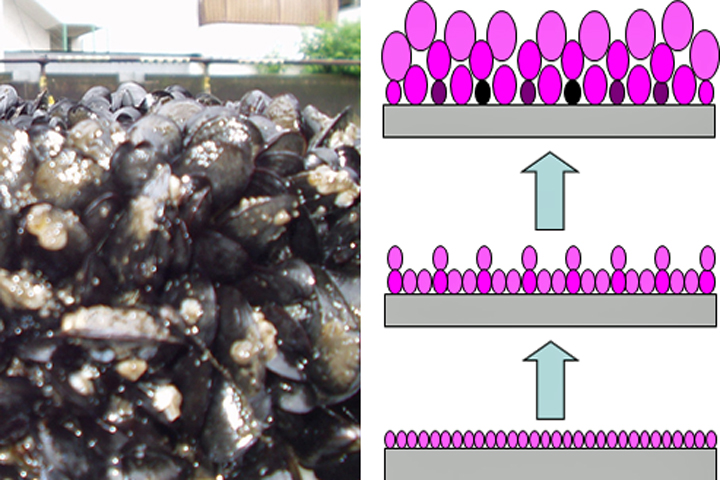
Sessile organisms can build up on artificial substrates with tens of centimeters thick. In order to understand the effects of sessile organisms on the surrounding water quality, active organisms and inactive organisms should be considered separately. Targeting the main sessile organisms, mussels, we estimated the proportion of active mussels by measuring the oxygen consumption rate of the mussel bed, and developed a competition model of mussels for space and food. We predicted the effects of mussels on the material cycle. Please see this page for details.
Electrochemical methods are attracting attention as one of the methods for protecting the water quality environment. Oxygen generated by electrolysis is supplied to hypoxic waters, and hydrogen is used as energy. It is also possible to decompose inorganic nitrogen compounds that cause eutrophication and red tide. Metallic electrodes are commonly used in electrolysis, but there is a risk that they will be consumed during use and ionized metals will be accumulated in aquatic organisms. Therefore, we are developing charcoal-contained electrodes and dielectric electrodes to reduce diffusion of materials from electrodes. We also research on the prevention of sessile organisms attached to fishing nets using electrochemical methods.
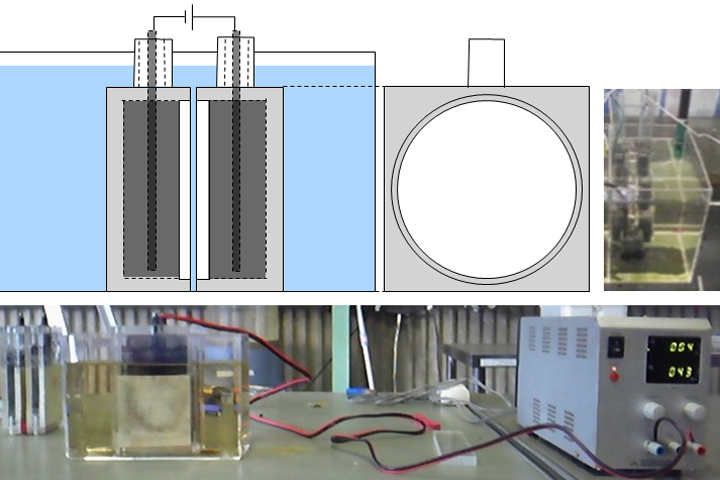
In order to develop electrodes that do not diffuse, we develop charcoal-contained electrodes that cover inexpensive charcoal with ceramics. If electrolysis is performed without encapsulating charcoal, the charcoal particles will gradually diffuse and the water will turn black and turbid. By electrolysis using a charcoal-contained electrode, the decomposition characteristics of ammonia nitrogen and other nutrients are investigated. The applicability of this electrolysis system to the treatment of polluted water is being investigated. In the future, we hope to apply it to the supply of oxygen and the production of hydrogen. Please see this page for details.
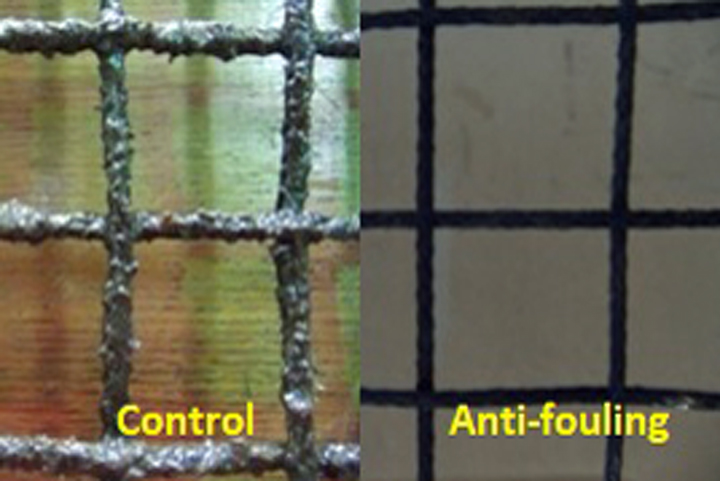
Many organisms adhere to fishing nets, and it takes a lot of effort to clean them. Anti-fouling paints are often used, but their impacts on the environment are feared and their duration is not so long. Therefore, we investigate a method of weaving a titanium wire into a fishing net to generate a small amount of hypochlorous acid by electrolysis to prevent biofouling from the fishing net. Please see this page for details.

